We research products independently. When you buy through links on this page, we may earn a commission from Amazon at no extra cost to you. As an Amazon Associate we earn from qualifying purchases. Read our affiliate disclosure.
The verdict up front: in the impulse sealer vs vacuum sealer question, the two tools do different jobs. A vacuum sealer removes the air and then seals, which is what you want for meat, fish and leftovers going into the freezer. An impulse sealer only seals, but it closes thick, smooth Mylar and wide bags that most vacuum sealers cannot handle, which is what you want for long-term dry storage with oxygen absorbers. If you do both, a chamber vacuum sealer can cover most of the overlap.
Most people end up here because they bought Mylar bags and discovered their FoodSaver will not vacuum them, or because they are setting up a pantry and wonder which machine to buy first. Here is how the two compare, side by side.
Our top picks at a glance


Side-by-side comparison
| Feature | Impulse sealer | External vacuum sealer | Chamber vacuum sealer |
|---|---|---|---|
| Removes air | No | Yes, through the bag mouth | Yes, from the whole chamber |
| Seals | Yes | Yes | Yes |
| Smooth Mylar | Seals it | Heat-seals it, cannot vacuum it | Vacuums and seals it |
| Bag type for vacuum | Not applicable | Embossed (channeled) bags and rolls | Smooth pouches (and embossed) |
| Liquids | Seals a bag of liquid closed, no vacuum | Liquids get pulled toward the seal | Seals liquids |
| Typical seal length | 8 to 12 in. hand models (longer exists) | About 11 to 12 in. | About 10 to 16 in. |
| Thick film | Built for it (AIE-305 rated to 8 mil) | Limited | Good (VacMaster VP210 seals Mylar to 7 mil) |
| Size and weight | Small and light | Countertop, a few pounds | Heavy: 13 to 72 lb and up |
| Price tier | Budget | Budget to premium | Mid-range to premium |
| Best for | Mylar with oxygen absorbers, chip bags, wide bags | Freezer meat, sous vide, leftovers | Both, plus soups and marinades |
The differences, one by one
What happens to the air
This is the whole difference. An impulse sealer clamps the bag and seals it shut, trapping whatever air is inside. A vacuum sealer pulls the air out first. For frozen food, air is the enemy: it causes freezer burn and oxidation. For dry storage in Mylar, an oxygen absorber does the air-removal job after the bag is sealed, so an impulse sealer is enough. Utah State University Extension explains that air is about 21% oxygen and 78% nitrogen; once an absorber takes up the oxygen, what remains is mostly nitrogen, which is why absorber bags do not shrink tight.
How the seal is made
An impulse sealer sends a short burst of current through a flat nichrome wire under a PTFE cover, only while you press the arm down, then lets the seal cool under pressure. Nothing stays hot between seals and there is no warm-up. A vacuum sealer has a heated strip that runs at the end of each vacuum cycle. Both make a fused seal; the impulse sealer usually gives you a wider, more controllable band on thick film. The AIE-305, for example, lays a 5 mm seal across 12 in.
Which bags each one handles
External vacuum sealers need embossed bags with channels for the air to escape. Smooth bags, including most Mylar, will heat-seal but will not vacuum. Impulse sealers do not care about texture; they will close smooth Mylar, foil pouches, poly bags and chip bags, within their thickness rating. Chamber sealers vacuum smooth pouches and Mylar because the air leaves the whole chamber, not just the bag mouth. Our Mylar vacuum seal bags guide lists which Mylar works on which machine.
Bag width
Most countertop vacuum sealers top out around 11 to 12 in. Impulse sealers come in 8, 12 and longer lengths, and you can buy one sized to your bags. A 5-gallon Mylar bucket liner, such as Wallaby's 20 x 30.5 in. bags, is far too big for any vacuum sealer, but you can close it with an impulse sealer in overlapping passes or with the household iron Wallaby also lists.
Liquids
Neither impulse nor external vacuum sealers are good with liquids, for different reasons. An impulse sealer will close a bag of soup, but leaves the air in. An external vacuum sealer pulls the liquid toward the seal. Only a chamber sealer vacuum-seals liquids reliably, because the pressure drops evenly inside and outside the bag.
Speed and effort
An impulse sealer is fast per bag: press, hold through the cooling phase, done. A vacuum sealer takes longer per bag because of the vacuum cycle, but it does more. For 40 bags of rice with absorbers, an impulse sealer is quicker. For 40 bags of chicken thighs, a vacuum sealer is the only one of the two that protects them in the freezer.
Cost to run
Impulse sealers use any bag you like, including cheap smooth poly and Mylar. External vacuum sealers need embossed bags or rolls, which cost more per bag than smooth film. Chamber sealers use cheaper smooth pouches, which is one reason heavy users switch to them; our chamber vs external sealer guide breaks down the trade-off.
Safety: what neither machine does
A sealed bag is not a preserved food. Clemson Cooperative Extension (HGIC 3865) says vacuum packaging is not a substitute for safely processing perishable foods meant for room-temperature storage, and that perishable vacuum-packaged food must stay in the refrigerator between 34 and 40 °F or in the freezer at 0 °F or below. The same applies to an impulse-sealed bag. For pantry storage with oxygen absorbers, Utah State University Extension says foods should be about 10% moisture or less, because moist foods in low-oxygen packaging can support botulism. Keep Mylar storage for truly dry foods like white rice, dry beans and wheat; see our guide to vacuum sealing rice, flour and dry goods.
Choose an impulse sealer if...
- You store dry foods in smooth Mylar bags with oxygen absorbers.
- You use gallon or 5-gallon Mylar bags that are wider than a vacuum sealer's bar.
- You own a freeze dryer and seal trays of food in Mylar every few days.
- You want to reseal chip, cereal and coffee bags quickly.
- You want the cheapest, lightest sealing tool.
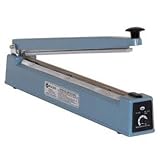
Best impulse sealer: AIE-305 (12 in. x 5 mm)
The AIE-305 is the model we recommend in our best heat sealers for Mylar bags. Its 12 in. length closes a 10 x 14 in. gallon Mylar bag in one press, and the 5 mm band forgives small wrinkles. Distributor spec sheets list it for material up to 8 mil at 850 W, and AIE lists Mylar among the films it seals. Confirm the voltage on the listing you buy, as one Amazon listing has shown 230 V.
Pros
- Seals thick, smooth Mylar
- No warm-up; heats only while pressed
- 12 in. covers gallon bags in one pass
Cons
- Removes no air
- You hold the arm through the cooling phase

AIE-305 Impulse Hand Sealer, 12 in. x 5 mm
by American International Electric
Choose a vacuum sealer if...
- You freeze meat, fish or game and want to prevent freezer burn.
- You cook sous vide.
- You portion leftovers and meal prep for the fridge or freezer.
- You want to vacuum jars and containers through an accessory hose.
Best vacuum sealer for most people: Nesco VS-12 Deluxe
The VS-12 is the external sealer we recommend most often. Nesco lists a 130 W, 25.1 inHg double vacuum pump, Dry, Moist and Double seal settings, Normal and Gentle pressure, pulse vacuum, roll storage with a cutter and a hose port, and bags up to 11.8 in. wide, with a 1-year warranty. For more choices, see our best vacuum sealers roundup.
Pros
- Double seal and Moist setting
- Gentle pressure and pulse for soft food
- Roll storage and cutter
Cons
- Cannot vacuum smooth Mylar
- One cycle every two minutes, per Nesco's manual
Choose a chamber sealer if...
- You want one machine for freezer meat, sous vide and Mylar.
- You seal soups, stocks or marinades often.
- You have the counter space and budget for a heavy machine.
Best machine that does both: VacMaster VP210
The VP210 is a dry-pump chamber sealer with a 10.25 in. double-wire seal bar, a chamber of 11.25 x 15.25 x 5 in. and pouches up to 10 x 13 in. VacMaster's listing says it seals Mylar up to 7 mil, so it vacuums and seals smooth Mylar as well as everyday chamber pouches and liquids. It weighs 72 lb, so it needs a permanent spot. Our best chamber vacuum sealers list has lighter options.
Pros
- Vacuums smooth Mylar and liquids
- Cheap smooth pouches
- Double-wire seal
Cons
- 72 lb
- Premium price tier
Can you use both together?
Yes, and many preppers do. Vacuum sealer for the freezer; impulse sealer for Mylar. A common combined method for dry goods in Mylar is to press out as much air as you can by hand, drop the oxygen absorber in last, and seal within minutes with the impulse sealer. If you own a textured Mylar bag and an external sealer, you can also vacuum seal the Mylar and add an absorber.
FAQ
What is the difference between an impulse sealer and a vacuum sealer?
An impulse sealer only heat-seals a bag closed; it removes no air. A vacuum sealer pulls the air out of the bag and then heat-seals it. Impulse sealers handle thick, smooth films like Mylar and large bag openings; vacuum sealers are for freezer and fridge food where removing air matters.
Can a vacuum sealer seal Mylar bags?
A countertop vacuum sealer can usually heat-seal a Mylar bag, but it cannot pull a vacuum on smooth Mylar because there are no air channels. Use textured Mylar bags for vacuum sealing on an external machine, or a chamber sealer, or an impulse sealer plus an oxygen absorber.
Is an impulse sealer the same as a heat sealer?
An impulse sealer is one type of heat sealer. It heats a wire only for the moment you press the arm down, then cools under pressure. Constant heat sealers stay hot all the time. Impulse models are the common choice for home Mylar storage because there is no warm-up and nothing stays hot.
Do I need an impulse sealer if I have a vacuum sealer?
Only if you seal smooth Mylar, wide bags or thick film often. A vacuum sealer handles freezer bags and rolls. An impulse sealer is the better tool for gallon and 5-gallon Mylar bags with oxygen absorbers, chip bags, and bags wider than your vacuum sealer's bar.
Can you use an impulse sealer for food?
Yes, for closing food bags. It removes no air, so it suits dry foods stored with oxygen absorbers in Mylar, or bags you only need closed. For meat in the freezer, a vacuum sealer protects quality better because it removes the air that causes freezer burn.